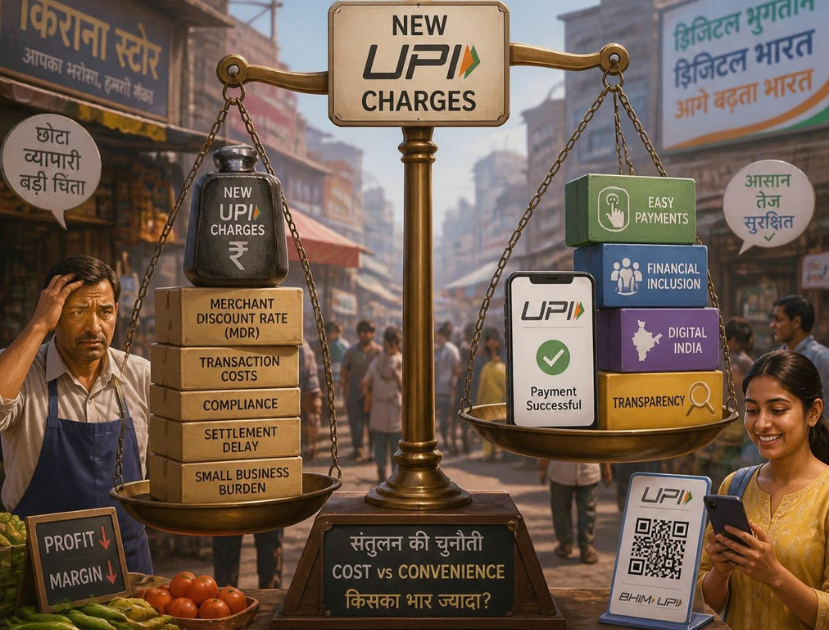
New UPI Charges From October 15, 2026
The new UPI charges taking effect on October 15, 2026, have created considerable confusion among the Indian diaspora in the UAE, many of whom rely on the Unified Payments Interface for everything from paying relatives back home to settling bills during annual visits. The good news for UAE-based NRIs is that the change is far narrower than the headlines suggest, and it won’t affect the everyday money transfers most people actually use UPI for. Still, understanding exactly what is changing, who bears the cost, and how it fits into the broader digital payments landscape in India will help NRIs avoid unnecessary worry and make smarter decisions with their money in the months ahead.
What Exactly Is Changing on October 15: New UPI Charges
The National Payments Corporation of India, which operates UPI, has introduced a revised Merchant Discount Rate framework following a Ministry of Finance gazette notification issued in September 2026. Under this framework, a baseline charge of 0.4 percent will apply to select person-to-merchant UPI transactions above Rs 2,000. This is not a fee charged to the person making the payment. It is a processing cost deducted from the amount the merchant receives, and it is shared among the banks, payment apps, and other participants that keep the UPI infrastructure running. For context, on a transaction of Rs 3,000, the merchant would see roughly Rs 12 deducted, while on a Rs 50,000 transaction the deduction would be about Rs 200. For very large transactions, the charge is capped at Rs 300, so it does not scale indefinitely.
A small number of merchant categories, including railways, telecom services, insurance, and fuel retailers, will instead attract a flat charge of Rs 5 per transaction above Rs 2,000, rather than the percentage-based MDR. Small and micro merchants who fall below a certain volume threshold remain exempt altogether, which was a deliberate design choice to protect the vendors and shopkeepers who form the backbone of India’s retail economy.
Why the Government Introduced This Change
UPI has grown at a staggering pace. According to figures cited by the Finance Ministry, the system processed over 2,451 crore transactions worth close to Rs 30 lakh crore in August 2026 alone, and more than 24,000 crore transactions worth over Rs 300 lakh crore across the 2025-26 financial year. That scale comes with real operating costs, including server capacity, fraud prevention systems, cybersecurity upgrades, and technical support across the 700-plus banks connected to the network. Industry estimates cited by the government put the annual cost of running this infrastructure at around Rs 20,000 crore, and a Parliamentary Standing Committee on Finance has previously noted that existing subsidies do not fully cover these expenses. The new MDR is essentially an attempt to build a sustainable funding model for UPI without asking ordinary users to pay for something that has always been free for them.
What This Means for Person-to-Person Transfers
This is the part that matters most to UAE NRIs. Person-to-person transfers, including the money sent to parents, siblings, or other relatives in India, remain completely free of charge. There is no MDR, no service fee, and no hidden deduction on P2P transfers regardless of the amount involved. Similarly, merchant payments of Rs 2,000 or below, which cover the vast majority of daily transactions such as groceries, chai stalls, and small retail purchases, continue to be free as well. The charge only kicks in on the merchant side of larger transactions, and even then, it is the business accepting the payment that absorbs the cost, not the customer swiping their UPI app.
How This Affects UAE NRIs Specifically
Many NRIs in the UAE use UPI in ways that go beyond simple remittances. Some make larger purchases while visiting India, such as buying electronics, furniture, or jewellery. Others use UPI to pay premiums on insurance policies, settle utility bills for property back home, or make investments through mutual fund platforms. In these scenarios, the person actually paying will not see any difference in the amount debited from their account. What might change, over time, is how merchants price their goods and services, since some businesses could choose to pass a portion of the MDR cost on to customers through slightly higher prices, particularly for high-value purchases. This is not a direct UPI charge, but rather an indirect market response that NRIs visiting India should keep in mind when making large purchases.
It is also worth remembering how UPI access works for the UAE diaspora in the first place. NRIs with NRE or NRO accounts can link their UAE mobile numbers directly to their Indian bank accounts and use UPI apps without needing an active Indian SIM card. This facility, enabled through cooperation between NPCI and several partner banks, has made it significantly easier for the community to transact digitally, whether they are physically in India or managing finances remotely from Dubai, Abu Dhabi, or Sharjah. The October 15 changes do not alter this access model in any way. NRIs will continue registering their UPI ID the same way, linking the same NRE or NRO accounts, and using the same set of supported banks and apps.
Currency Conversion Is a Separate Matter
One point of confusion worth clarifying is the difference between the new MDR and currency conversion charges. When a UAE NRI makes a payment in dirhams that gets converted to rupees, or vice versa, any conversion fee or foreign exchange margin applied by the bank or payment app is entirely separate from the Indian merchant MDR. UPI apps are expected to display the payment amount in both currencies, along with the applicable exchange rate and any conversion fee, before the customer confirms the transaction. NRIs should read this screen carefully, not because of the new MDR, but because conversion margins have always existed independently of it and can vary between providers.
Practical Steps for UAE NRIs Going Forward
There is no action required from UAE NRIs to continue using UPI as they always have. Existing UPI IDs, linked bank accounts, and saved merchant details will keep working exactly as before. The only sensible precaution is to be mindful when making large one-time payments to a merchant, since the deducted MDR could, in theory, influence how that business prices its goods over time. It is also a good idea to keep bank KYC details updated, particularly the linked international mobile number, since any lapse there could disrupt UPI access regardless of the MDR changes. For those managing property, investments, or recurring payments in India from the UAE, this is also a reasonable moment to review overall financial arrangements and confirm that account linkages, nominee details, and compliance documents are current.
A Word on Staying Compliant While Managing Finances Across Borders
Digital payment changes like this one are a useful reminder that NRI finances in India involve more than just moving money conveniently. Tax residency rules, reporting obligations for NRE and NRO accounts, and the treatment of income earned or received in India can all shift depending on how funds move and how much time an individual spends in the country each year. Getting this wrong, even unintentionally, can create complications that are far more costly than any transaction fee.
About My Taxman
My Taxman works with NRIs across the UAE and the wider Gulf region to make sense of exactly these kinds of cross-border financial questions. Whether it is understanding how new UPI rules interact with high-value transactions, filing income tax returns for NRE and NRO account activity, structuring investments in India in a tax-efficient way, or staying compliant with FEMA and residency requirements, the team at My Taxman offers practical, India-specific guidance built around the realities of living and earning abroad. For UAE NRIs who want clarity on how regulatory changes like the October 15 MDR framework fit into their broader financial picture, reaching out to My Taxman is a straightforward way to get accurate, personalised advice rather than relying on assumptions or forum threads.