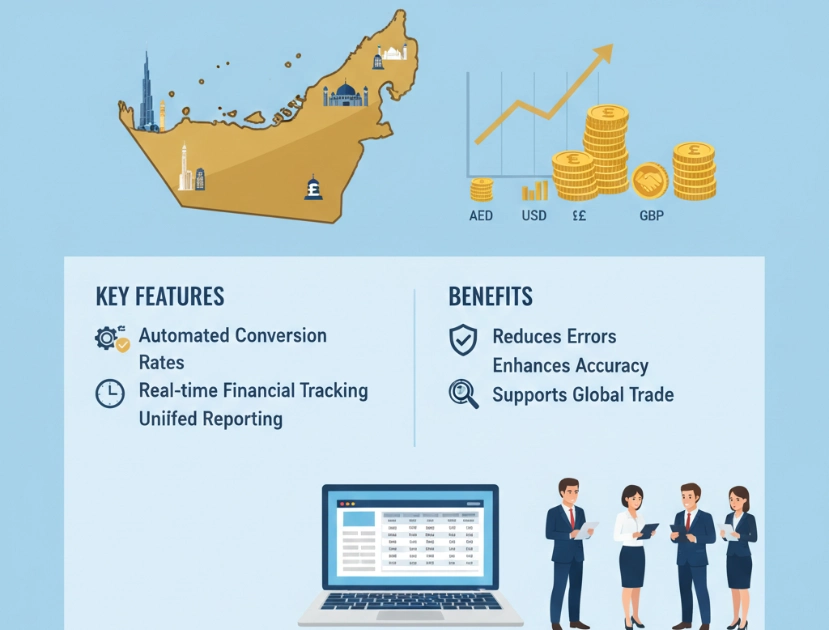
Multi-Currency Accounting for UAE Traders is no longer a complex option reserved for multinational corporations. It has become a necessity for businesses operating in the dynamic and globally connected marketplace of the UAE. Whether you are importing goods from Europe, exporting to Asia, or trading in US dollars within the region, dealing with multiple currencies directly impacts your accounting records, tax compliance, and financial performance.
The UAE’s position as a global trading hub means businesses frequently transact in USD, EUR, GBP, CNY, and other currencies. While the UAE Dirham (AED) is pegged to the US Dollar, fluctuations in other currencies can significantly affect profitability. Understanding exchange rate rules, accounting standards, and financial risks is essential for traders who want to remain compliant and financially stable.
The Growing Importance of Multi-Currency Accounting for UAE
The UAE’s strategic location between East and West makes it a gateway for international trade. Cities like Dubai and Abu Dhabi host thousands of trading companies dealing with cross-border suppliers and customers daily. These businesses issue invoices in foreign currencies, maintain foreign bank accounts, and settle transactions in various denominations.
When a UAE trader purchases goods from a European supplier in euros and sells them locally in AED, exchange rate fluctuations create accounting differences. These differences must be recorded correctly to avoid misstated profits or losses.
Inaccurate currency conversion can distort financial statements, affect VAT reporting, and even lead to compliance issues under UAE regulations. This is why proper systems and professional guidance are crucial.
Exchange Rate Rules Under UAE Accounting Standards
Functional Currency and Reporting Currency
Under International Financial Reporting Standards (IFRS), which are widely followed in the UAE, every business must determine its functional currency. For most UAE traders, the functional currency is AED. However, if the majority of transactions occur in USD or another currency, the functional currency may differ.
The reporting currency, on the other hand, is the currency in which financial statements are presented. Most UAE-based businesses report in AED, even if they transact in multiple currencies.
Initial Recognition of Foreign Currency Transactions
When a foreign currency transaction occurs, it must be recorded at the exchange rate prevailing on the transaction date. For example, if a trader imports goods worth USD 10,000, the amount must be converted to AED using the exchange rate applicable on that specific date.
This becomes particularly important for VAT reporting under the Federal Tax Authority. The FTA requires businesses to convert foreign currency amounts into AED using the Central Bank’s published exchange rate on the date of supply.
Failure to apply the correct exchange rate may result in inaccurate VAT returns and potential penalties.
Subsequent Measurement and Year-End Adjustments
Foreign currency monetary items such as receivables and payables must be revalued at the closing rate on the reporting date. Any difference between the original exchange rate and the closing rate is recognized as a foreign exchange gain or loss.
For example, if a USD receivable was recorded at AED 3.67 per dollar and the closing rate changes slightly due to market movements, the adjustment must be recorded in the profit and loss account.
This process ensures financial statements reflect the true economic position of the business at year-end.
VAT Implications of Multi-Currency Transactions
VAT Conversion Requirements
Under UAE VAT law, businesses must convert foreign currency invoices into AED before filing VAT returns. The exchange rate used must align with the UAE Central Bank rate on the date of supply.
This means traders cannot simply use bank conversion rates or internal estimates. The official rate must be applied consistently to avoid discrepancies during tax audits.
Impact on Input and Output VAT
Exchange rate fluctuations can impact both input VAT on purchases and output VAT on sales. If not properly recorded, differences may arise between accounting records and VAT filings.
For traders handling large volumes of imports and exports, even small exchange rate variations can result in noticeable financial differences. This makes accurate multi-currency accounting critical for compliance and cash flow management.
Foreign Exchange Risks Faced by UAE Traders
Transaction Risk
Transaction risk occurs when exchange rates fluctuate between the time a transaction is agreed upon and when it is settled. For example, a UAE trader agrees to pay a UK supplier in GBP. If the pound strengthens before payment, the trader ends up paying more in AED terms.
This risk directly affects profit margins.
Translation Risk
Translation risk arises when financial statements of foreign operations are converted into AED for reporting purposes. While not always affecting cash flow, it impacts reported earnings and balance sheet values.
Businesses with overseas branches or subsidiaries often face this challenge.
Economic Risk
Economic risk is broader and relates to long-term changes in exchange rates affecting competitiveness. For instance, if a currency significantly depreciates, suppliers from that country may become cheaper, impacting local market pricing strategies.
Managing Multi-Currency Risks Effectively
Hedging Strategies
Many traders use forward contracts to lock in exchange rates for future payments. This protects against adverse fluctuations. Banks in the UAE offer hedging solutions tailored to trading businesses.
Although hedging may involve costs, it provides predictability and protects margins.
Maintaining Foreign Currency Accounts
Opening foreign currency bank accounts allows traders to receive and hold payments in the same currency as their payables. This natural hedge reduces unnecessary conversions and associated losses.
Corporate Tax Considerations
With the introduction of UAE Corporate Tax, foreign exchange gains and losses also impact taxable income. Proper classification of realized and unrealized gains is essential.
If not recorded correctly, exchange differences may distort taxable profits. Businesses must ensure that forex gains and losses are accurately reflected in financial statements prepared under IFRS.
Professional advice is highly recommended to avoid errors in corporate tax filings.
Common Mistakes in Multi-Currency Accounting
Many UAE traders make the mistake of using inconsistent exchange rates across departments. Sales teams may use bank rates, while finance departments apply Central Bank rates. This inconsistency creates reconciliation issues.
Another common issue is failing to revalue outstanding receivables and payables at year-end. This leads to misstated assets and liabilities.
Additionally, some businesses overlook the impact of currency fluctuations on pricing strategies, which can gradually erode profit margins.
Best Practices for UAE Traders
To ensure smooth operations, businesses should establish clear exchange rate policies. The selected rate source must be consistent and compliant with regulatory requirements.
Regular reconciliation of foreign currency accounts is necessary. Monthly revaluations help prevent large year-end adjustments.
Training finance teams on IFRS requirements and VAT rules enhances accuracy. Internal controls and audit reviews further strengthen compliance.
Most importantly, businesses should seek professional support when managing complex multi-currency transactions.
The Future of Multi-Currency Accounting in the UAE
As the UAE continues expanding its trade relations globally, multi-currency transactions will only increase. Digital currencies, cross-border e-commerce, and international supply chains are reshaping the accounting landscape.
With regulatory frameworks evolving and corporate tax in place, compliance requirements are becoming more sophisticated. Traders must stay proactive, invest in technology, and seek expert guidance to remain competitive.
The ability to manage currency risks effectively can become a strategic advantage rather than just a compliance necessity.
About My Taxman
At My Taxman, we understand the challenges that come with managing international trade and foreign currency transactions in the UAE. Our team of experienced tax consultants and accounting professionals provides comprehensive support in multi-currency accounting, VAT compliance, corporate tax advisory, and financial reporting.
We help UAE traders implement robust accounting systems, ensure accurate exchange rate application, and manage foreign exchange risks effectively. Whether you are a startup importer or an established trading company, My Taxman offers tailored solutions designed to protect your business and enhance profitability.
Partner with My Taxman to simplify compliance and focus confidently on growing your global trade operations.