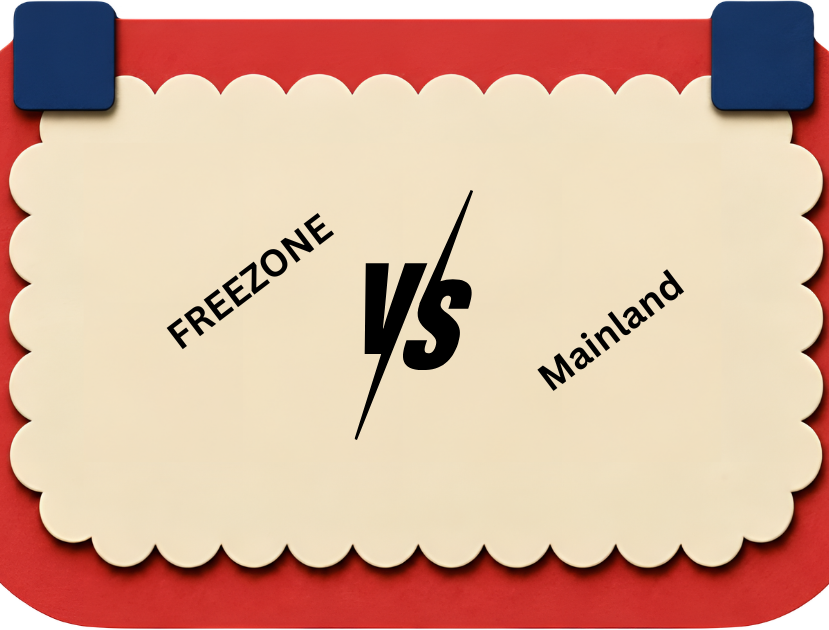
Freezone vs Mainland: Which Is More Tax-Efficient for UAE SMEs in 2026?
Freezone vs Mainland UAE is one of the most important considerations for entrepreneurs and small and medium-sized enterprises (SMEs) planning to establish or expand their businesses in the UAE in 2026. While both business structures offer unique commercial advantages, the introduction of the UAE Corporate Tax regime has significantly changed how companies evaluate their setup options. Tax efficiency is no longer determined solely by the place of incorporation; it now depends on factors such as business activities, eligibility for corporate tax incentives, compliance obligations, and long-term growth plans.
For many SMEs, choosing between a Free Zone company and a Mainland company is not simply a licensing decision. It is a strategic financial choice that can affect profitability, operational flexibility, and regulatory compliance. Understanding the tax implications of each structure is essential for making an informed decision in today’s evolving business environment.
Understanding Freezone vs Mainland Businesses in the UAE
Before comparing tax efficiency, it is important to understand the difference between Free Zone and Mainland companies.
A Free Zone company is established within one of the UAE’s designated Free Zones, each governed by its own authority. These zones were created to encourage foreign investment by offering incentives such as simplified company formation, full foreign ownership, and industry-focused infrastructure. Free Zones cater to various sectors including technology, logistics, healthcare, finance, manufacturing, media, and professional services.
A Mainland company, on the other hand, is licensed by the relevant Department of Economy in each Emirate. Mainland businesses have greater flexibility in conducting commercial activities throughout the UAE without geographical restrictions. They can freely serve government entities, private companies, and consumers across the country while also engaging in international trade.
Although both structures can enjoy full foreign ownership for many activities, the tax treatment differs depending on whether a Free Zone entity qualifies for preferential corporate tax treatment.
UAE Corporate Tax Framework in 2026
The UAE Corporate Tax regime continues to apply a standard corporate tax rate of 9% on taxable income exceeding the applicable threshold. However, Free Zone businesses may qualify for a 0% corporate tax rate on qualifying income if they meet the conditions applicable to a Qualifying Free Zone Person (QFZP).
This distinction has made tax planning considerably more important for SMEs. While some businesses may significantly benefit from the Free Zone regime, others may find that a Mainland setup better supports their commercial objectives despite paying corporate tax.
The decision should therefore be based on overall tax efficiency rather than focusing solely on headline tax rates.
Corporate Tax Treatment for Free Zone Companies
Qualifying Free Zone Person Status
One of the biggest tax advantages available to Free Zone companies is the possibility of qualifying as a Qualifying Free Zone Person. Businesses meeting the prescribed conditions may continue benefiting from a 0% corporate tax rate on qualifying income.
To maintain this status, companies generally need to satisfy various requirements relating to adequate substance, qualifying activities, transfer pricing compliance, audited financial statements where required, and adherence to all relevant tax regulations.
Failure to meet these conditions may result in the loss of preferential tax treatment.
Qualifying Income
Not all income earned by a Free Zone company automatically qualifies for the 0% tax rate. Certain categories of income qualify, while others may become subject to the standard corporate tax rate.
Income generated from transactions with other Free Zone entities may qualify under specific circumstances. Income derived from qualifying activities may also benefit from preferential treatment.
However, income from certain transactions with Mainland customers may be taxable unless specifically permitted under the regulations.
As a result, businesses must carefully evaluate their revenue sources before assuming they qualify for tax benefits.
Compliance Responsibilities
Although Free Zone companies may benefit from reduced tax rates, compliance obligations remain substantial.
Companies are generally required to register for corporate tax, maintain proper accounting records, prepare financial statements, comply with transfer pricing documentation where applicable, and file annual tax returns.
The misconception that Free Zone companies are completely exempt from tax compliance is no longer accurate under the current corporate tax framework.
Corporate Tax Treatment for Mainland Companies
Mainland businesses generally fall under the standard UAE Corporate Tax regime.
Taxable income exceeding the applicable threshold is generally subject to corporate tax at 9%. Although this represents an additional tax cost compared to qualifying Free Zone entities, Mainland companies enjoy significantly greater commercial flexibility.
Businesses can operate anywhere within the UAE, bid for government contracts, establish multiple branches, and freely conduct business with customers throughout the domestic market without many of the operational restrictions applicable to certain Free Zone companies.
For SMEs serving primarily UAE-based customers, this flexibility may outweigh potential tax savings available through a Free Zone structure.
VAT Considerations
Tax efficiency extends beyond corporate tax. Value Added Tax (VAT) also influences the overall financial position of SMEs.
Both Free Zone and Mainland companies are subject to UAE VAT rules where registration thresholds are met. However, certain Designated Zones enjoy special VAT treatment for the movement of goods under specific conditions.
It is important to understand that Designated Zones are not entirely VAT exempt. Supplies of services remain generally subject to standard VAT rules, while the VAT treatment of goods depends on various regulatory conditions.
Businesses should therefore assess VAT implications alongside corporate tax when selecting a business structure.
Operational Flexibility and Commercial Opportunities
Advantages of Mainland Companies
Mainland businesses enjoy unrestricted access to the UAE domestic market. They can directly serve consumers, private companies, government departments, and public sector organisations without requiring intermediaries.
For SMEs targeting rapid domestic expansion, this flexibility often creates greater long-term value than purely tax-related advantages.
Advantages of Free Zone Companies
Free Zone companies often benefit from simplified incorporation procedures, sector-specific infrastructure, international business communities, and customs-related advantages for import and export activities.
Businesses focusing primarily on international trade, consulting, technology services, logistics, manufacturing, or exports may find Free Zones particularly attractive.
The operational model should therefore align with the company’s customer base and long-term strategy.
Compliance Costs Should Not Be Ignored
Many SMEs focus exclusively on tax rates while overlooking compliance costs.
Maintaining Qualifying Free Zone Person status often requires careful documentation, transfer pricing assessments, economic substance considerations, and ongoing monitoring of qualifying income.
Similarly, Mainland companies must maintain accounting records, comply with corporate tax obligations, and ensure timely VAT filings where applicable.
When evaluating tax efficiency, businesses should consider the total cost of compliance rather than comparing tax percentages alone.
Business Growth Considerations
The right business structure today may not remain the most efficient option tomorrow.
An SME initially serving overseas clients through a Free Zone may later expand into the domestic UAE market. As commercial activities evolve, tax implications may also change.
Likewise, a Mainland business focused on local clients may later establish Free Zone entities for export operations or regional headquarters.
Business owners should therefore adopt a long-term perspective rather than selecting a structure based solely on immediate tax savings.
Which Structure Is More Tax-Efficient?
Free Zone May Be More Tax-Efficient If
Businesses primarily serve international markets, conduct qualifying activities, maintain compliance with QFZP requirements, and generate qualifying income. In these cases, the availability of the 0% corporate tax rate may provide meaningful tax savings while supporting international operations.
Mainland May Be More Tax-Efficient If
Businesses generate most of their revenue from customers within the UAE, regularly contract with government entities, require unrestricted domestic operations, or anticipate rapid expansion across multiple Emirates. Although corporate tax applies, operational flexibility may result in greater overall profitability.
Ultimately, tax efficiency should be measured by considering total business performance rather than tax rates alone.
Common Mistakes SMEs Should Avoid
Many SMEs mistakenly assume every Free Zone company automatically qualifies for 0% corporate tax. Others believe a Mainland company is always less attractive because it pays corporate tax.
These assumptions can lead to poor business decisions.
Another common mistake is failing to review customer location, revenue streams, transfer pricing obligations, or compliance costs before selecting a business structure.
Businesses should also avoid making decisions based solely on company formation costs without considering future tax consequences.
Professional tax planning remains one of the most valuable investments for growing SMEs.
Preparing for 2026 and Beyond
As the UAE tax environment continues to evolve, SMEs should periodically review their business structure to ensure it remains commercially and financially efficient.
Regular tax health checks, financial reviews, compliance assessments, and strategic planning enable businesses to adapt to regulatory changes while maximising available tax benefits.
Whether operating from a Free Zone or the Mainland, maintaining proper accounting records, accurate tax reporting, and proactive compliance will remain essential for long-term success.
Conclusion
Choosing between a Free Zone and a Mainland company is no longer simply a matter of licensing preferences. Under the UAE Corporate Tax regime in 2026, tax efficiency depends on business activities, customer location, qualifying income, compliance obligations, and future growth objectives.
For internationally focused SMEs that meet the conditions of a Qualifying Free Zone Person, a Free Zone structure may provide significant tax advantages. For businesses serving the UAE domestic market, a Mainland company may offer greater operational flexibility despite being subject to corporate tax.
The most tax-efficient structure is the one that aligns with your commercial strategy, operational needs, and compliance capabilities. Before making a decision, SMEs should seek professional tax advice to evaluate both immediate tax implications and long-term business objectives.
About My Taxman
My Taxman is a trusted UAE tax and accounting consultancy dedicated to helping businesses navigate the country’s evolving tax landscape. Our experienced professionals provide expert guidance on corporate tax, VAT, excise tax, accounting & bookkeeping, financial reporting, tax planning, audits, and business advisory services. Whether you are establishing a Free Zone company, expanding into the Mainland, or reviewing your corporate tax position, My Taxman delivers tailored solutions that ensure compliance, minimize tax risks, and support sustainable business growth across the UAE.