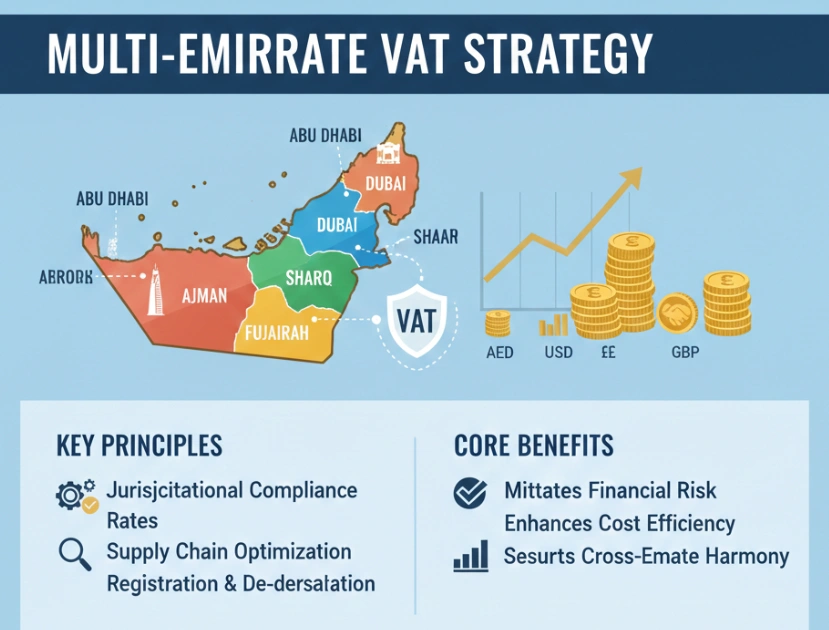
The Multi-Emirate VAT Strategy is becoming increasingly important for businesses operating across multiple emirates in the UAE. As companies expand from Dubai to Abu Dhabi, Sharjah, or other regions, VAT compliance becomes more complex. While the UAE operates under a federal tax system governed by the Federal Tax Authority, businesses with branches or operations in more than one emirate often face challenges in reporting, documentation, and compliance management.
Understanding when centralised filing is necessary—and how to structure your VAT processes accordingly—can save your company from penalties, duplication of effort, and compliance risks.
Understanding VAT in the UAE
The UAE introduced VAT in 2018 at a standard rate of 5%. Unlike countries with state-level tax systems, VAT in the UAE is federally regulated. This means that regardless of whether your business operates in Dubai, Abu Dhabi, or any other emirate, the VAT laws are consistent nationwide.
However, operational complexity arises when businesses expand across multiple emirates. For example, a company headquartered in Dubai with branches in Abu Dhabi and Sharjah may face logistical challenges in tracking transactions, managing input and output VAT, and consolidating records.
Even though VAT is federal, operational execution differs depending on where your offices, warehouses, and service locations are situated. That’s where a well-planned Multi-Emirate VAT Strategy becomes crucial.
Why Multi-Emirate Operations Complicate VAT Compliance
When businesses operate within one emirate, VAT filing is relatively straightforward. However, multi-emirate operations introduce factors such as inter-branch transfers, decentralized accounting systems, and inconsistent documentation processes.
A company with warehouses in different emirates may transfer goods internally. Although transfers between branches under the same legal entity are not considered taxable supplies in most cases, accurate documentation is still required. Errors in reporting such movements can lead to discrepancies during audits.
Similarly, businesses offering services across emirates may generate revenue in multiple locations while maintaining centralised accounts. Without a structured VAT approach, it becomes difficult to track taxable supplies accurately.
When Do UAE Businesses Need Centralized Filing?
In the UAE, VAT registration is linked to the legal entity, not to each branch. If your company operates under a single trade license but has branches in multiple emirates, you are generally required to file a single VAT return covering all operations.
Centralized filing becomes necessary in the following situations:
Single Legal Entity with Multiple Branches
If your company has branches in Dubai, Abu Dhabi, and Sharjah under one legal entity, you must submit one consolidated VAT return through the FTA portal. Separate filings for each branch are not permitted unless each branch is registered as a separate legal entity.
Centralized Accounting Structure
Many medium and large enterprises maintain centralized accounting departments. When financial data from all branches is consolidated into one ERP system, centralized VAT filing ensures accuracy and compliance.
VAT Group Registration
Businesses operating under multiple legal entities may apply for VAT group registration if they meet the FTA’s eligibility criteria. Under VAT grouping, the parent and subsidiaries are treated as one taxable person for VAT purposes. In such cases, centralized filing becomes mandatory.
Benefits of a Multi-Emirate VAT Strategy
A well-designed Multi-Emirate VAT Strategy does more than ensure compliance—it enhances financial transparency and operational efficiency.
Improved Compliance Control
Centralized filing reduces the risk of inconsistent reporting. When one dedicated team handles VAT submissions, there is better oversight of deadlines, reconciliations, and supporting documents.
Reduced Administrative Burden
Instead of each branch preparing its own calculations, a centralised system consolidates financial data. This saves time and minimises duplication.
Stronger Audit Readiness
The FTA has increased its audit activities in recent years. Businesses with structured documentation and centralised VAT management are better prepared to respond to audit queries.
Challenges in Implementing Centralised Filing
While centralised filing offers benefits, implementing it effectively requires careful planning.
Data Integration Issues
Companies operating in multiple emirates often use different accounting systems. Without integration, consolidating data for VAT reporting becomes complicated.
Inter-Branch Reconciliations
Reconciling transactions between branches can be time-consuming. Differences in reporting timelines or documentation standards may create inconsistencies.
Industry-Specific Complexities
Industries such as real estate, logistics, and construction frequently operate across emirates. For example, a real estate developer managing projects in both Dubai and Abu Dhabi must carefully track VAT on construction contracts, subcontractor invoices, and property sales.
Role of the Federal Tax Authority
The Federal Tax Authority oversees VAT compliance, audits, and enforcement across the UAE. All VAT returns must be submitted through the FTA’s online portal, regardless of where the business operates.
The FTA expects accurate record-keeping for at least five years. For businesses dealing in real estate, records must often be retained longer. Centralized filing simplifies this requirement by consolidating records in one secure system.
Non-compliance penalties can be significant. Errors in VAT returns, late submissions, or failure to maintain documentation can lead to financial penalties and reputational damage.
Practical Steps to Build a Strong Multi-Emirate VAT Strategy
Developing an effective Multi-Emirate VAT Strategy requires a structured approach.
First, ensure that all branches operate under standardised accounting procedures. Uniform invoicing formats, documentation standards, and reporting timelines help maintain consistency.
Second, implement an integrated accounting or ERP system that consolidates data from all emirates in real time. Automation reduces human error and ensures accurate VAT calculations.
Third, conduct periodic internal VAT reviews. Regular reconciliations between input VAT, output VAT, and general ledger accounts help identify discrepancies before filing deadlines.
Finally, seek professional guidance when expanding operations. VAT implications should be assessed before opening new branches or entering new emirates.
VAT Grouping vs. Separate Registration
For businesses with multiple subsidiaries operating in different emirates, VAT grouping may be beneficial. Under group registration, all entities are treated as a single taxable person.
However, VAT grouping requires careful evaluation. All group members become jointly liable for VAT obligations. While this simplifies filing, it also increases collective risk exposure.
Companies must assess financial control, ownership structure, and compliance history before opting for VAT grouping.
The Future of VAT Compliance in the UAE
As the UAE continues to grow as a global business hub, regulatory oversight is becoming more robust. Digital reporting systems, data analytics, and stricter audit processes are reshaping compliance expectations.
Businesses expanding across emirates must prioritize centralized VAT management. A reactive approach to compliance is no longer sufficient. Instead, companies need proactive strategies that align operational growth with tax efficiency.
Multi-emirate expansion presents tremendous opportunities, but without a solid VAT framework, it can create compliance vulnerabilities.
Why Centralised Filing Is a Strategic Advantage
Beyond compliance, centralized VAT filing strengthens financial governance. It provides leadership with a clear overview of tax liabilities and cash flow implications.
For CFOs and finance managers, a unified VAT process improves forecasting accuracy. It ensures that VAT recoveries and payments are planned effectively, avoiding unexpected liabilities.
Moreover, centralised filing enhances transparency during mergers, acquisitions, or investor due diligence processes. Organised tax records reflect operational maturity and financial discipline.
Conclusion
Multi-Emirate VAT Strategy is no longer optional for businesses operating across the UAE. While VAT laws are federally governed, operational realities differ across emirates. Centralized filing ensures compliance, improves efficiency, and strengthens audit readiness.
As businesses expand beyond one emirate, they must move beyond fragmented accounting practices and adopt integrated VAT processes. Centralised VAT filing not only reduces risk but also supports sustainable growth.
About My Taxman
My Taxman is a trusted UAE-based tax consultancy firm specialising in VAT registration, VAT return filing, corporate tax advisory, and compliance support. With extensive experience in handling multi-emirate operations, My Taxman helps businesses design efficient VAT strategies tailored to their operational structure. Whether you operate in one emirate or across the UAE, My Taxman ensures accurate filings, regulatory compliance, and peace of mind so you can focus on growing your business confidently.