UAE SME Board Structure
UAE SME Board Structure is no longer a concept reserved for large corporations. In today’s competitive and highly regulated business environment, small and medium-sized enterprises in the UAE are increasingly realising the importance of structured governance. What begins as a founder-led venture driven by passion and agility eventually reaches a stage where informal decision-making is no longer sustainable. Growth demands accountability, clarity, transparency, and strategic oversight.
In the UAE, where SMEs form the backbone of the economy, formal governance is becoming a critical factor for long-term success. As businesses expand, attract investors, enter partnerships, or prepare for succession, establishing a proper board structure becomes essential rather than optional.
Understanding Governance in UAE SMEs
Governance in SMEs refers to the systems, processes, and structures that guide decision-making, accountability, and strategic direction. While many founders initially manage operations independently, the complexity of scaling a company in the UAE requires a shift from informal leadership to structured oversight.
The UAE’s regulatory landscape has matured significantly over the past decade. Authorities such as the Ministry of Economy and financial regulators like the Securities and Commodities Authority emphasize transparency, compliance, and responsible management practices. Even privately held SMEs are expected to maintain clear financial reporting, defined roles, and ethical business standards.
As SMEs expand into free zones such as Dubai Multi Commodities Centre or mainland jurisdictions governed by the Department of Economy and Tourism, regulatory requirements can become more sophisticated. This is where a formal board structure begins to add measurable value.
When Founders Should Consider Formal Governance
Every founder driven SME eventually reaches a turning point. It may occur when revenue grows rapidly, when external investors show interest, or when operational complexity increases beyond the founder’s direct control.
Rapid Business Growth
As revenues increase and teams expand, the decision-making burden becomes overwhelming for one or two founders. Without a structured governance model, inconsistencies arise, accountability weakens, and operational risks multiply. A board introduces strategic focus and separates oversight from daily management.
Seeking External Investment
Investors, whether venture capitalists, private equity firms, or institutional partners, expect transparency and accountability. They want oversight mechanisms that protect their capital. A formal board structure demonstrates professionalism and reduces perceived risk.
Succession Planning
Family-owned SMEs are common across the UAE. As first-generation founders plan succession, governance ensures smooth leadership transition. A board creates continuity and minimizes conflicts between stakeholders.
Regulatory and Compliance Pressure
As financial regulations tighten, companies must maintain accurate financial records, internal controls, and compliance frameworks. Governance structures provide oversight and reduce legal exposure.
Key Components of a UAE SME Board Structure
A properly designed SME board structure balances oversight with flexibility. Unlike large corporations, SMEs must maintain agility while introducing accountability.
Board of Directors
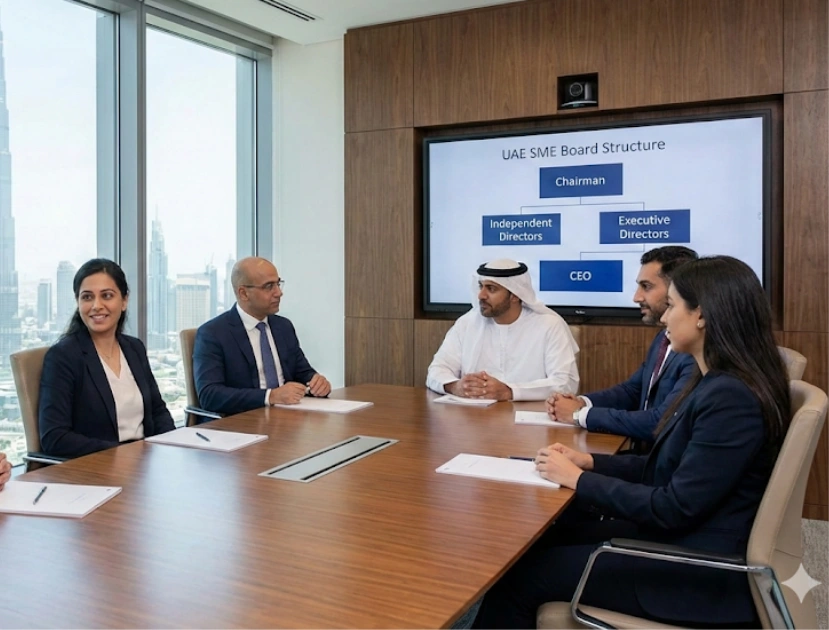
The board is responsible for strategic direction, risk oversight, and protecting shareholder interests. In SMEs, the board often includes founders, independent directors, and sometimes investor representatives. Independent directors add objectivity and external expertise.
Advisory Board
Some SMEs start with an advisory board before forming a formal board of directors. Advisory boards offer non-binding guidance but help founders adapt to structured governance. This transitional step can be particularly helpful for early-stage businesses.
Committees
As companies grow, subcommittees such as audit or risk committees may be formed. Even if not legally required, they demonstrate commitment to governance best practices.
Defined Roles and Responsibilities
Clear separation between ownership, board oversight, and executive management prevents conflicts. Founders who serve as both CEO and board chair must establish transparency to avoid concentration of authority.
The UAE Legal Context for SME Governance
The UAE Commercial Companies Law introduced significant reforms that impact corporate governance. While the law primarily addresses larger entities, its principles influence SMEs, especially those structured as Limited Liability Companies (LLCs).
Free zone regulations also incorporate governance expectations. For example, entities registered in the Abu Dhabi Global Market or Dubai International Financial Centre operate under internationally aligned corporate governance frameworks.
Although many SMEs are not legally required to appoint independent directors, doing so can significantly enhance credibility.
Benefits of Formal Governance for UAE SMEs
Transitioning to a formal board structure offers both tangible and intangible benefits.
First, it strengthens strategic direction. Boards focus on long-term growth rather than daily operational challenges. This prevents reactive decision-making.
Second, governance improves risk management. The UAE’s dynamic market environment exposes SMEs to regulatory, financial, and operational risks. Board oversight helps identify vulnerabilities early.
Third, it enhances investor confidence. Transparent reporting, structured oversight, and independent review mechanisms signal reliability.
Fourth, governance supports sustainable growth. A board creates accountability systems that allow founders to step back from operational micro-management and focus on innovation.
Finally, it protects the founder’s legacy. Structured governance ensures that the company continues to thrive beyond its original leadership.
Challenges Founders Face When Implementing Governance
Despite its benefits, transitioning to formal governance can feel uncomfortable. Founders often worry about losing control. The shift from centralized authority to shared oversight requires mindset change.
There may also be cost considerations. Independent directors, compliance advisors, and board administration involve financial commitments. However, these costs are typically outweighed by the long-term value of improved governance.
Cultural adaptation is another challenge. In many SMEs, decisions are relationship driven. Introducing structured board meetings, documented resolutions, and performance evaluations requires discipline and transparency.
Building the Right Board Structure
The effectiveness of a board depends not on size but on composition and clarity. For most UAE SMEs, a small board of three to five members works well.
Diversity of expertise is crucial. Including members with financial, legal, industry, and strategic backgrounds creates balance. Independent directors should bring impartial perspectives.
Clear board charters and meeting protocols must be established. Frequency of meetings, voting procedures, conflict-of-interest policies, and reporting standards should be documented.
Most importantly, founders must embrace governance as a strategic asset rather than a regulatory burden.
Governance as a Growth Catalyst
Formal governance is not about bureaucracy; it is about structure that supports ambition. The UAE continues to position itself as a global business hub, attracting international investors and partnerships. SMEs that align with governance standards stand out in this competitive ecosystem.
As businesses prepare for expansion into regional or global markets, governance becomes even more critical. International partners expect professionalism and transparency. A robust board structure signals readiness for global collaboration.
In many cases, the transition to formal governance marks the true evolution from startup to mature enterprise.
Conclusion
UAE SME Board Structure is a strategic necessity for founders who aim to scale sustainably, attract investment, and ensure long-term continuity. While informal management may work in the early stages, growth demands accountability and oversight. By establishing a formal board structure aligned with UAE regulations and best practices, SMEs can strengthen resilience, build investor confidence, and safeguard their future.
Governance is not about losing control; it is about building a foundation for enduring success in one of the world’s most dynamic business environments.
About My Taxman
My Taxman is a trusted UAE-based consultancy specialising in tax advisory, accounting, corporate structuring, and compliance solutions for SMEs and growing enterprises. With deep expertise in UAE regulations, My Taxman helps businesses establish strong financial governance frameworks that align with federal and free zone requirements. From VAT compliance to corporate tax planning and financial reporting, My Taxman supports founders in building structured, transparent, and growth-oriented businesses across the UAE.
FAQS
Why is a Board Structure Important for UAE SMEs?
A board structure provides strategic oversight, accountability, and structured decision-making. For UAE SMEs experiencing growth, informal leadership may create bottlenecks and risk exposure. A board separates operational management from strategic supervision, ensuring balanced decisions. It also enhances investor confidence and improves compliance with evolving UAE regulations. By introducing governance mechanisms early, SMEs can build stronger financial discipline and risk management systems, which are essential for sustainable expansion in competitive markets like Dubai and Abu Dhabi.
At What Stage Should a Founder Introduce Formal Governance?
Formal governance should be considered when a company experiences rapid growth, seeks external investment, expands operations, or plans succession. If decision-making becomes complex or risks increase, governance structures provide clarity and control. Waiting too long can create operational inefficiencies and compliance challenges. Early implementation, even through an advisory board, allows smooth transition without disrupting company culture.
Is a Board Legally Required for UAE SMEs?
Not all SMEs are legally required to have a board of directors, especially private LLCs. However, companies operating in certain jurisdictions like financial free zones, may have stricter requirements. Even when not mandatory, adopting governance best practices strengthens credibility and reduces legal and operational risks. Voluntary governance often positions SMEs more favourably with investors and financial institutions
What is the Difference Between a Board of Directors and an Advisory Board?
A board of directors holds formal authority and fiduciary responsibilities, making binding decisions and overseeing management. An advisory board provides strategic guidance without legal authority. Many SMEs begin with advisory boards before transitioning to formal boards. This approach allows founders to gain external insights while maintaining flexibility during early growth stages.
How Many Board Members Should an SME Have?
Most SMEs function effectively with three to five board members. A smaller board encourages efficient decision-making while providing diverse expertise. The focus should be on quality rather than quantity. Including independent members with financial or industry expertise enhances governance effectiveness and credibility.
Can Founders Remain on the Board After Implementing Governance?
Yes, founders often remain on the board and may serve as chairpersons or executive directors. However, it is important to separate board oversight from daily management. Clear role definitions prevent conflicts of interest and ensure balanced governance.
How does Governance Improve Investor Confidence?
Investors look for transparency, accountability, and risk management. A formal board structure signals that the company is professionally managed. Structured reporting, independent oversight, and documented decision-making reduce uncertainty and perceived risk, making the SME more attractive to investors.
What Challenges do SMEs Face in Adopting Governance?
Common challenges include founder resistance, perceived loss of control, costs, and cultural adjustments. However, these challenges can be managed with gradual implementation, advisory support, and clear communication. Over time, governance strengthens business resilience and long-term stability.