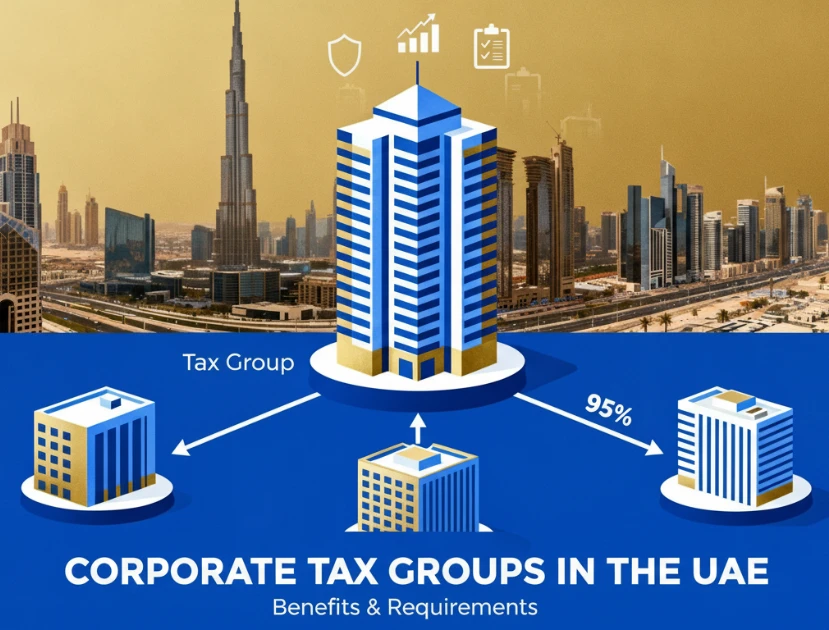
A Guide to Corporate Tax Groups in the UAE
Corporate Tax Groups in the UAE represent one of the most strategic features of the country’s corporate tax framework, allowing related companies under common ownership to consolidate their tax obligations into a single filing. This optional regime, governed by Article 40 of the Corporate Tax Law (Federal Decree-Law No. 47 of 2022), enables businesses operating multiple entities to optimize tax compliance, reduce administrative burdens, and leverage group-wide financial planning opportunities.
What is a Corporate Tax Group?
A Corporate Tax Group is defined as two or more taxable persons (corporate entities) treated as a single taxable person for corporate tax purposes in the UAE. Only resident persons—companies that are UAE tax residents—can participate in a Tax Group, and formation requires approval from the Federal Tax Authority (FTA).
Once a Tax Group is formed, the parent company and its wholly- or majority-owned subsidiaries are treated as a single taxable entity. Instead of each company calculating and submitting separate tax returns, the parent company files one consolidated tax return on behalf of the entire Tax Group, streamlining compliance and administrative processes.
Eligibility Criteria for Formation
To form a Corporate Tax Group in the UAE, companies must satisfy specific conditions established by the Corporate Tax Law. The parent company must own at least 95% of the share capital, voting rights, and entitlement to profits and net assets of each subsidiary, whether directly or through intermediary entities.
All entities must be UAE tax residents, share the same financial year-end, and prepare financial statements using the same accounting standards (typically International Financial Reporting Standards). Certain entities are excluded from Tax Group formation, including Free Zone Companies benefiting from the 0% corporate tax rate (unless they opt for the 9% rate), regulated financial institutions, exempt persons under UAE corporate tax law, and companies failing the 95% ownership test.
Key Benefits of Tax Groups
Forming a Corporate Tax Group offers substantial advantages for multi-entity business structures operating in the UAE. The streamlined tax filing process allows the parent company to submit a single consolidated return, significantly reducing administrative workload and the risk of errors or non-compliance across multiple entities.
One of the most significant financial benefits is the ability to offset losses within the group. Profitable subsidiaries can offset losses from other group members in the same tax period, optimizing the overall tax liability without requiring separate loss transfer applications. The AED 375,000 corporate tax exemption applies once to the entire group’s combined taxable income rather than individually to each member, which can provide tax savings for groups with multiple small entities.
Formation and Registration Process
Establishing a Corporate Tax Group requires careful preparation and documentation. Companies must prepare comprehensive documentation including trade licenses of all entities, financial statements of the parent company and all subsidiaries, an organizational chart showing ownership percentages, and a signed Tax Group Agreement among all entities.
The parent company submits the application through the FTA online portal, and the FTA may request additional documents or clarifications during the review process. Once approved, the Tax Group receives a Tax Identification Number (TIN), and the parent company assumes responsibility for all filing and compliance obligations on behalf of the group.
New Requirements for 2025
Significant changes to Tax Group requirements took effect in 2025 under Ministerial Decision No. 301 of 2024. Tax groups must now prepare and maintain audited aggregated financial statements for each tax period, aggregating standalone financial statements of all group members while eliminating intra-group transactions.
The aggregation follows specific rules including line-by-line aggregation of all financial statement captions, elimination of income, expenses, and unrealized gains/losses between group members, and investments in non-group entities carried at cost less impairment. Companies forming tax groups before 2025 must retroactively apply these requirements to earlier periods, representing a significant compliance consideration.
Ongoing Compliance Obligations
While Tax Groups simplify certain aspects of compliance, they also introduce important ongoing obligations that all members must understand. All group members are jointly and severally liable for the group’s tax obligations, meaning if one entity fails to pay, the FTA can recover the amount from other group members.
The 95% ownership requirement must be maintained at all times throughout the Tax Group’s existence. Any changes in ownership structure or failure to maintain the required ownership percentage may require group restructuring or dissolution. The parent company must monitor these requirements continuously and report any material changes to the FTA promptly.
Consolidated vs. Individual Filing
Understanding when Tax Group consolidation makes sense requires analyzing your specific business structure and financial position. Tax Group formation is entirely optional, and companies should evaluate whether the benefits outweigh the compliance requirements and joint liability risks.
For groups where some entities consistently generate losses while others are profitable, consolidation enables immediate loss offsetting within the same tax period. Alternatively, companies can utilize tax loss transfers between entities with at least 75% common ownership without forming a formal Tax Group, allowing separate filings while still benefiting from loss utilization.
Membership Limitations and Restrictions
There is no limit to the number of members that can join a Tax Group, allowing large corporate structures to consolidate multiple subsidiaries under one filing. However, a juridical person can only be a member of one Tax Group at any given time, preventing entities from participating in multiple overlapping tax consolidations.
If a parent company forms a Tax Group with one or more subsidiaries, they are regarded as a single Tax Group, and it is not possible for a parent company to form multiple separate Tax Groups with different subsidiary combinations. This structure ensures clarity in tax administration and prevents complex overlapping arrangements.
Strategic Considerations
When evaluating whether to form a Corporate Tax Group, businesses should consider both immediate and long-term implications. The joint liability provision means that financially strong entities become liable for obligations of weaker group members, which could pose risks if any subsidiary encounters financial difficulties.
The requirement for audited aggregated financial statements introduces additional costs and administrative requirements that must be factored into the decision. Companies should conduct thorough cost-benefit analyses comparing the tax savings and administrative efficiencies against the compliance costs and liability risks before proceeding with Tax Group formation.
Expert Guidance with My Taxman
Navigating the complexities of Corporate Tax Groups requires specialized expertise in UAE tax regulations and FTA compliance procedures. The formation process, ongoing obligations, and strategic implications demand professional guidance to ensure optimal outcomes for your business structure.
My Taxman provides comprehensive corporate tax advisory services throughout the UAE, specializing in Tax Group formation, compliance, and optimization strategies. Our team of qualified tax consultants has extensive experience helping businesses evaluate whether Tax Group formation aligns with their strategic objectives and guiding them through every step of the process.
We assist with eligibility assessments to determine if your corporate structure meets the 95% ownership and residency requirements, prepare all necessary documentation including tax group agreements and organizational charts, and manage the entire FTA application and approval process. Our services include preparing audited aggregated financial statements that comply with 2025 requirements, ongoing compliance monitoring to ensure continued eligibility, and strategic tax planning to maximize the benefits of group consolidation while minimizing risks.
Whether you’re considering forming a new Tax Group, managing an existing one, or exploring alternative loss transfer arrangements, My Taxman delivers the expertise needed to navigate UAE corporate tax efficiently. Contact us today at mytaxman.ae to schedule a consultation and discover how Corporate Tax Groups can optimize your business’s tax position while ensuring full compliance with Federal Tax Authority regulations.